


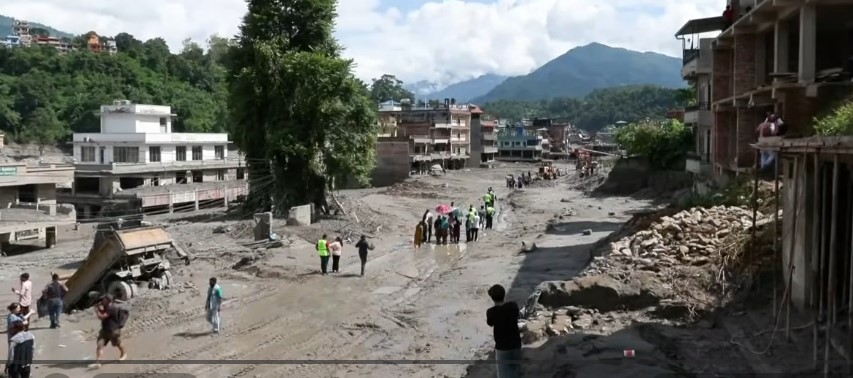
Newsman: The death toll in Nepal has increased again, reaching at least 579. Nepal Police said this afternoon. Of the 937 people missing, 517 are foreign nationals and 127 are nonresident Nepalis visiting Nepal, the National Disaster Risk Reduction and Management Authority said Friday afternoon local time.
The State Department says 90 Americans are unaccounted for in Nepal and China, while three have been rescued in Nepal. It said it was not aware of any U.S. deaths.
The catastrophic flash floods occurred along the border between Nepal and China’s Tibet region, authorities in Nepal said.
, The greatest number of bodies, 221, has been recovered in the Chitwan district, the police said, dozens of miles downstream from the hardest-hit areas.
Rescue operations have resumed in both China and Nepal after they were briefly suspended amid fears of renewed flooding. In China, where a mudslide hit a land crossing between Nepal and Tibet’s Gyirong County, authorities said five people were dead and 558 others were missing, including 260 foreigners.
The US State Department has urged U.S. citizens “currently in, or recently traveling through Rasuwa or another affected area” to get in touch.
Citizens in the flood-hit areas should “email [email protected] with your full name, current location, status, and name of tour or trekking company,” a spokesperson said in a statement.
The spokesperson said relatives seeking information about family members in Nepal “should call 1-888-407-4747 toll-free from the United States and Canada, or 1-202-501-4444 from other locations.”
Those seeking information about family members in China “should call 010-8531 4000 from China or 011-86-10-8531 4000 from the United States,” the spokesperson added.
The U.S. Embassy in Nepal said a range of supplies requested by the Nepali government is being delivered. The emergency supplies include food, blankets, mosquito nets and insulating foam sheets for temporary shelter flooring.
The U.S. embassies in Nepal and China are working closely with local tour agencies and local authorities to assist Americans in the affected areas as Nepali-led search-and-rescue operations continue, the spokesperson said. Around 90 Americans are thought to have been affected by the floods, and so far three Americans have been rescued.
Nepal Police reported yet another rise in the death toll today, which now stands at 553 people.The area with the highest number of bodies recovered remains Chitwan, far downstream from the hardest-hit areas. The number of people injured and rescued stands at nearly 1,500, police said.
Nepali authorities say they’re monitoring two lakes upstream from the main flood zone, one of which began overflowing today, according to Reuters, which quoted a disaster management authority official.
The official said that flood risks will remain until the two lakes are fully drained. The exact location and number of these lakes are unclear due to cloudy satellite imagery and the presence of several river bodies and valleys.
More than 90,000 people are believed to be affected by the Himalayan landslide, the Red Cross said as fears of additional flooding grew.
“We’re of course very concerned about the secondary flood,” David Fisher, head of delegation for the International Federation of Red Cross and Red Crescent Societies in Nepal, said today, according to Reuters.
He said trucks carrying relief supplies had also been blocked after the banks of a lake formed by the landslide broke.
The deadly torrent followed a glacial collapse in the Himalayan region, which is home to many of the world’s highest peaks and a high concentration of glaciers. Hundreds of foreign tourists are among those who remain missing in the area, which is popular with trekkers and pilgrims.
Nepal’s hard-hit district of Rasuwa has been reconnected to the national road network, aiding rescue efforts as hundreds of people remain missing. The road connecting Nepal’s capital, Kathmandu, to the town of Dhunche in Rasuwa has reopened for four-wheeled light vehicles, the National Disaster Risk Reduction and Management Authority said.
Rasuwa, on Nepal’s northern border with China, suffered some of the worst damage in this week’s catastrophic flooding, which swept away multiple bridges and 25 miles of road, cutting off thousands of people.
Rescue operations have resumed after being briefly suspended early today amid fears of new flooding from a lake that formed as a result of Wednesday’s glacial collapse and subsequent flash floods. Chinese officials said today that the death toll in Gyirong County had increased to five from three. The number of people missing remained at 558, including 260 foreign nationals.
Scores of bodies recovered along the banks of the Trishuli and Narayani rivers have been brought to the city of Pokhara on Phewa Lake in central Nepal for identification, officials said.
Both Nepal and China were forced to temporarily suspend rescue operations today amid concerns about new flood risks following the catastrophic glacial collapse this week.
Indian nationals missing numbers update
There are 320 Indian nationals missing after the mudslide and flood disaster on the Nepal-Tibet border, the Indian Foreign Ministry said, up from 288 reported yesterday.
“Please do keep in mind that we are in a dynamic situation, so figures keep going up and down,” ministry spokesperson Randhir Jaiswal said at a news conference. “Also, we have to reconcile several lists that we are dealing with.”
Jaiswal said that 21 Indian nationals from the state of Tamil Nadu who arrived yesterday in Nepal’s capital, Kathmandu, from the flood-affected area were now in Delhi and that 63 Indian nationals working at the Trishuli-1 hydropower project had also been rescued.
He said there were also about 100 people of Indian origin who remained unreachable, many of whom were on a pilgrimage to Mount Kailash, a high-altitude site in Tibet that is revered by Hindus and Buddhists. On the Chinese side, 400 Indian nationals are now safe and have been in touch with their families, Jaiswal said.
As of Friday afternoon local time, 121 foreign travelers have been rescued, the Nepal Tourism Board said, including 85 from India, 16 from China, nine from South Korea and two from the U.S.
They also include two each from Russia and Italy, one each from Bulgaria and Switzerland, and three whose nationalities have not been confirmed.
China’s Xi sends condolences to president of Nepal
Chinese leader Xi Jinping sent a message of condolence to Nepali President Ramchandra Padel, as both of their countries continued to search for hundreds of missing people.
“Xi emphasized that China is making every effort to search for the missing, relocate and shelter affected residents, treat the injured promptly, minimize casualties, and prevent secondary disasters,” Xinhua, China’s state-run news agency, reported.
Xi also presided over a meeting of China’s Politburo to direct rescue work, where officials called for stronger dynamic monitoring and early-warning capabilities and improved ability to identify risks along disaster chains, Xinhua said.
At least 39 Australians are missing after the Nepal-China floods, the Australian government said, up from an earlier estimate of 34.
Foreign Minister Penny Wong also said Australia was providing 5 million Australian dollars ($3.6 million) in humanitarian assistance.
“The extraordinary scale of this disaster and the remoteness of the affected region mean immense challenges lie ahead for the response and recovery,” she said in a statement today.
The floodwaters that smashed through Nepali villages Wednesday are the latest in a series of catastrophic events in the Himalayas associated with rising temperatures and shifting high alpine ice and rock.
About 30 Canadians and permanent residents are missing after catastrophic flooding in Nepal and the Tibet region, the Canadian government said.
“Given the extremely difficult circumstances on the ground, this number will fluctuate as new information comes in,” it said in a statement yesterday.
Today, Nepal and China said the lake on the Tibet side, which is just 7 miles upstream of the Gyirong border crossing that was entirely wiped out on Wednesday, was leaking water. The lake is carrying over 2 million cubic meters of water and formed around 3,000 feet above the border crossing. Chinese authorities said yesterday that rainfall could more than double the size of the lake in the next three days.
Both countries said today that rescue operations had been temporarily suspended.
Nepal refuses foreign rescue help
Hundreds of foreign nationals are still missing, including from India, South Korea, Australia and the United States. But Nepal said it was managing the rescue efforts.
Nepal government said it does not need international assistance with search-and-rescue operations following the devastating flash flood, despite offers of help from several countries with nationals missing in the disaster.
“The offer for help is natural. Our security agencies are doing the search and rescue operation. For now we don’t require such help,” Lok Bahadur Chhetri, spokesperson for the foreign ministry, said today without providing further details.
The Chinese foreign ministry said the death toll from a mudslide and flood disaster on the Nepal-Tibet border had risen to five, up from three earlier. The number of people who are unaccounted for remains the same at 558, including 260 foreigners.
Ministry spokesperson Lin Jian also said both sides had confirmed the cause of the disaster as a high-altitude glacial collapse. Chinese rescue efforts are concentrated in Tibet’s Gyirong County, which was hit by a mudslide at a land crossing between China and Nepal.
The Himalayan region — which includes Nepal, India, Pakistan, Bhutan, China and Afghanistan — is among the places most vulnerable to climate change in the world, with temperatures rising faster than the global average. Rising temperatures are accelerating glacial melt, further destabilizing a region that is already prone to floods, landslides and earthquakes.
They could also increase the likelihood of glacial collapses, like the one that occurred yesterday. The disaster is thought to have begun when a massive amount of ice and rock crashed into the valley below,
UN U.N. resident coordinator in Nepal
“The roads are destroyed and so it’s extremely, extremely difficult to have access,” Lila Pieters Yahia, the U.N. resident coordinator in Nepal, said at a news conference. “We have electricity which has been disrupted, about 10% in the total area. And in total, we have about 10,000 households, which are in immediate need.”
About 25 miles of road have been damaged, she said.
“The government has established a relief fund, and already the World Bank, India, China and the U.S. have committed to pledge $229 million to support,” she said, adding that the U.N. is also providing $2 million from its humanitarian relief fund for immediate assistance.

