


Akm Shehabuddin Kisslu: The UN Security Council reported that Syria’s new government is cooperating with international inspectors to find and destroy remaining chemical weapons from the previous Assad regime
The United Nations disarmament Chief told the Security Council Thursday, that the Organization for the Prohibition of Chemical Weapons (OPCW) has verified the destruction of 42 aerial bombs declared by Syria as part of its chemical weapons program, marking the first time since 2014 that the watchdog has confirmed the destruction of Syrian chemical munitions.
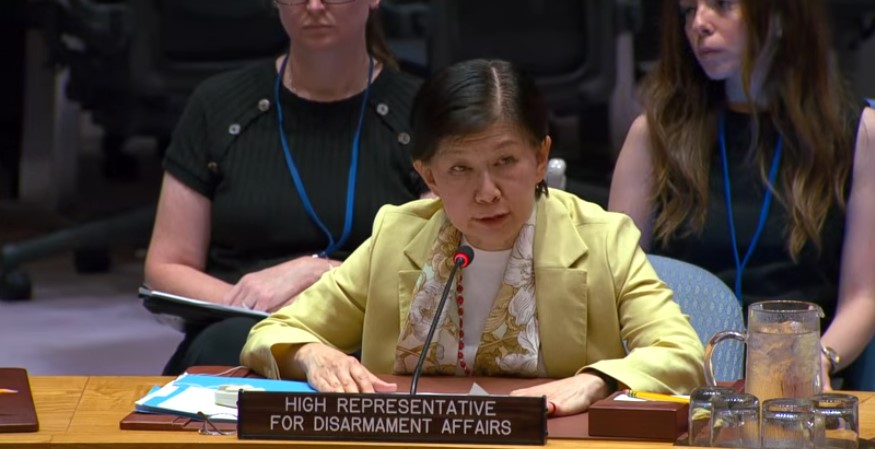
Briefing the Council on the implementation of resolution 2118 (2013), Izumi Nakamitsu, High Representative for Disarmament Affairs, said the OPCW and Syria had achieved “significant progress” in efforts to eliminate remnants of the previous Government’s chemical weapons programme.
Ms. Nakamitsu noted that the OPCW Executive Council approved agreements for storage sites in Al Qutayfah and Homs and a plan for the destruction of Category 3 chemical weapons at the Al Qutayfah Chemical Weapons Destruction Facility.
During an August 2026 deployment, OPCW inspectors verified that inventories matched Syria’s declarations and confirmed the irreversible destruction of 42 aerial bombs.
She also noted that the OPCW Executive Council reinstated Syria’s rights and privileges under the Chemical Weapons Convention in July 2026.
She reaffirmed UN support for OPCW and pledged continued efforts to uphold the global norm against chemical weapons.
“Our work to eliminate the Assad regime’s chemical weapons program and to promote accountability is not just essential for international peace and security, it is also a way to honor the Syrian men, women and children whose lives were taken,” she emphasized, adding: “Let their memory stir us onward as we work toward a Syria and a world finally free of chemical weapons.”
Spotlighting a “historic moment”, Syria’s representative announced that his country is destroying the chemical weapons found there by OPCW. “This is the very first destruction process since we have been liberated from the previous regime,” he said.
This demonstrates,he emphasized, that this file can be transformed into “a model of what diplomacy, coupled with determination, genuine political will and international cooperation, can achieve on the ground”. Further, this represents a “profound political transformation in Syria’s approach to safeguarding — and I repeat, safeguarding — the multilateral system”.
He added that every site secured and every piece of ammunition identified removes a danger to both Syria and the world, and Syria is preparing to hold the first court hearing for the use of such weapons. “All of this in a file in which we are the victims, not the perpetrators,” he stressed.
The Russian Federation’s delegate said that the OPCW Technical Secretariat has politicized the issue — “to find so-called concealed elements of the military chemical programme in [Syria] with a focus on accusing the former Government of crimes using chemical weapons”. He urged the Technical Secretariat to act professionally.
“The inability of the [OPCW] to fulfill its work properly — and the lack of desire in its Technical Secretariat to correct the methodology that it has used in the past, which was wrong — is a key problem preventing the implementation in full of resolution 2118 (2013).”
China said that the accountability functions of “highly controversial” investigative teams exceed the mandate given by the Chemical Weapons Convention. OPCW accountability mechanisms relating to Syria have further politicized its work, “seriously undermining its authority and effectiveness”. He stressed that restoring the “technical nature” of OPCW is “a key condition for resolving the issue of Syria’s chemical weapons”.
However, the representative of Türkiye underlined the “considerable challenges” associated with destruction efforts. He cited the clandestine nature of the former regime’s chemical weapons programme, exacerbated by Israeli airstrikes targeting potentially relevant sites following the fall of that regime.
“Such actions carry serious risks”, he stressed, noting that they may release hazardous materials and endanger civilians in surrounding areas. “They may also result in the destruction of evidence that could prove indispensable for establishing the facts and ensuring accountability for past chemical-weapons attacks,” he observed.
The representative of France, Council President for September, spoke in his national capacity to also underline his country’s readiness to provide OPCW and Syria “all necessary financial, technical and political support in carrying out their work”.

