


Akm Shehabuddin Kisslu: The United Nations Security Council has raised concerns that Al-Qaida in the Indian Subcontinent (AQIS). The concern was highlighted in the 38th report of the UN Security Council’s Analytical Support and Sanctions Monitoring Team on the Islamic State and Al-Qaida. Member States expressed concern that the conflict could create opportunities for terrorist groups, generating additional security challenges for the region. The new challenges and concerns as the Islamic State and Al-Qaida continued to evolve into a regional terrorist entity that includes Bangladesh as the new hub for these International terrorist groups.
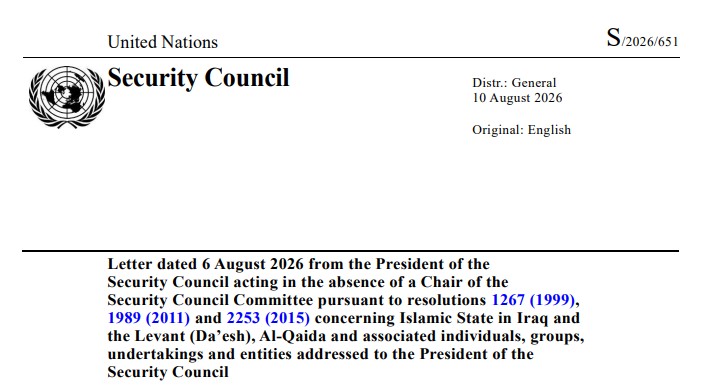
The report by the UNSC’s monitoring team released on August 10th, 2026 warned that the Al-Qaeda in the Indian Subcontinent (AQIS) is operating in Bangladesh using current situation in an effort to establish its terrorist networks and footholds within the country.
The UN Security Council’s Analytical Support and Sanctions Monitoring Team highlighted concerns over AQIS growing stronger than before, operating through decentralized small cells, and attempting to establish base networks within Bangladesh.
According to the UN report, AQIS is not operating as a single large organization; instead, it is active within Bangladesh through small units and dispersed networks to avoid detection.
Furthermore, it noted that AQIS has not broken down into small groups out of weakness, but is rather transitioning into stronger regional terrorist entities, targeting Bangladesh to expand its financial and logistical networks.
The UN’s warning regarding AQIS operations in Bangladesh comes as 1,611 militants reportedly resume activities in the country, with over 370 individuals charged under counter-terrorism laws remaining at large.
The report said the November 2025 attack on Delhi’s Red Fort was officially attributed to AQIS and noted concerns over the group’s attempts to use Bangladesh as a base for establishing cells. AQIS, not listed, continued to evolve from a fragmented group into a regional terrorist entity; it established logistics and financial networks, working in decentralized small, scattered cells instead of large units.
“One member state [of security council] assessed that al-Qaeda is shaping AQIS (al-Qaeda in the Indian Subcontinent) to spread its operations into neighboring Bangladesh, India-administered Jammu and Kashmir, and Myanmar,” said the report published on July 25.
The report submitted pursuant to resolution 2734 (2024) concerning ISIL, Al-Qaida and associated individuals and entities. The report said in its summary, ‘The threat level remained broadly unchanged. However, it intensified in the Sahel and South Asia. Al-Qaida senior leadership remained marginalized. Its capability and intent to conduct external operations remained unclear.’
According to the report, “Al-Qaida in the Indian Subcontinent (AQIS, not listed) continued to evolve from a fragmented group into a regional terrorist entity; it established logistics and financial networks, working in decentralized small, scattered cells instead of large units. The attack in November 2025 on the Red Fort in Delhi was officially attributed to AQIS. There was some concern about AQIS trying to exploit Bangladesh to establish cells there.
Report reads, Regional tensions in South Asia remained high as cross-border attacks between
Pakistan and Afghanistan continued. The de facto authorities (Taliban) continued their support to the Tehrik-e Taliban Pakistan (TTP), which escalated attacks against Pakistan, provoking military exchanges.
The terrorist threats in the region according to the report, “the terrorist threat emanating from Afghanistan remained largely unchanged. The ability of numerous terrorist groups to operate in Afghanistan constituted an enduring threat to neighboring countries and the Central Asian region. Despite efforts by the de facto authorities to combat Islamic State in Iraq and the Levant Khorasan (ISIL-K, QDe.161) and contain other terrorist groups, the authorities were unable to suppress the terrorist problem.”
The greatest threat to the de facto authorities and the broader region remained ISIL-K.4 As a result of counter-terrorism operations by Pakistan and the de facto authorities; it suffered serious setbacks, notwithstanding its continuing intent to conduct external operations. Counter-terrorism operations by the Taliban, primarily in the north and major cities, including Kabul, diminished ISIL-K capabilities, report reads.
ISIL-K as the most serious terrorist threat in Afghanistan and the wider region, benefiting from increased operational capabilities inside Afghanistan. ISIL-K is estimated to have from 4,000 to 6,000 members, including family members, the report added.
The report said according to their team assessment of the UN security council’s Analytical Support and Sanctions team , the al-Qaeda core in Afghanistan remains stable at 30 to 60 members, while all al-Qaeda fighters in the country are estimated to be 400, reaching 2,000 with family members and supporters included, the report read.
“Certain limited elements of AQIS are ready to either join or collaborate with Islamic State in Iraq and the Levant-Khorasan (ISIL-K),” the report said.
Attacks declined in Afghanistan but increased in Pakistan. ISIL-K was in a rebuilding phase, with renewed capability for infrequent but high-profile mass casualty attacks, reflecting its resilience and adaptability. Regional Member States reported that ISIL-K had modern tactical equipment, including drones, night vision devices and thermal imagers, and received training in urban combat and the use of drones. One Member State reported that ISIL-K and the Baloch Liberation Army (BLA, not listed) shared facilitation networks for the provision of logistics.
ISIL-K reportedly moved to the northern part of Afghanistan. It dispersed its training across the Pakistan-Afghanistan border region, including Khyber Pakhtunkhwa, as well as maintaining some presence in the Kabul suburbs.
Report said, On 25 December, following its annual rahbari shura (leadership council), TTP announced a revised structure with two new divisions covering: (a) Balochistan and the central region; and (b) Kashmir and the division of Gilgit. The restructuring included a new division described as the TTP Air Force.
TTP continued to escalate attacks on Pakistan. At the beginning of March, the group announced in multiple languages its spring campaign, “Operation Khyber”,calling for increased attacks in and against Pakistan, targeting security forces and civilians,report says. One of the deadliest attacks occurred on 16 February in the Bajaur district of Khyber Pakhtunkhwa, where a vehicle-borne improvised explosive device killed 11 security personnel and one child; wounding others. TTP claimed responsibility, reportedly operating from Afghanistan.
The de facto authorities of Afghanistan relocated approximately 2,000 TTP fighters and families from the Pakistani border to further inside Afghanistan, seeking to rein in TTP. The Taliban leader, Hibatullah Akhundzada, reportedly warned the TTP leadership through back‑channel communications to halt attacks targeting Pakistan or risk losing the Taliban’s support according to the UN Monitoring team report.
Al-Qaida’s official media outlet, the As-Sahab Media Foundation, published astatement supporting the Taliban and, for the first time, TTP in operations against Pakistan. While Al-Qaida provided ideological guidance, training and support to TTPin the latter’s insurgency against Pakistan, this public statement was more direct. One Member State reported that BLA terrorists were trained along with TTP by Al-Qaida trainers in Afghanistan.
AQIS formed the backbone of Ittihad-ul-Mujahideen Pakistan (IMP). It was reportedly responsible for multiple attacks, including, on 9 May, a suicide bombing and detonation of a vehicle-borne improvised explosive device near a security post in Bannu, Khyber Pakhtunkhwa, resulting in 21 deaths. In the same location, on 22 February, another such device was rammed into a military convoy, killing two people. The IMP leader was reported to be Waqas, alias Kalim Ullah. The AQIS leadership reportedly remained in Kabul, having been issued tazkiras, suggesting close cooperation between the Taliban and AQIS, report says.
Report reads , Regional Member States reported that ETIM/TIP was growing, concentrating in Badakhshan, including the Wakhan corridor, and had reportedly establishhed new strongholds in Kunduz. The ETIM/TIP overall leader, Abdul Haq (QDi.268), ordered an increase in combat readiness through the purchase of weapons and military equipment. One Member State noted that ETIM/TIP was training its militants in Al-Qaida’s newly established training camp at Barg-e Matal, Nuristan. Regional Member States reported that the group emphasized investment and the development of drones. As noted (S/2026/44, para. 94), the group continued to urge its members in the Syrian Arab Republic to move to Afghanistan, and reportedly some have relocated. One Member State assessed that the group was small, not growing, militarily inactive, did not have access to advanced drones or capability to manufacture such drones and was constrained by the Taliban.
South-East Asia
In South-East Asia, the threat from ISIL (Da’esh)-linked entities and residual Al-Qaida influence continued to be fragmented and decentralized. The operationalapacity of Islamic State in Iraq and the Levant in South-East Asia (ISIL-SEA, QDe.169) and affiliated regional networks declined, but risks persisted through dispersed cells, self-radicalized actors, and online recruitment and loosely connected inspired networks. As a result of growing concern for the recruitment and radicalization of minors online, Australia, Indonesia and Malaysia banned social media for children less than 16 years.
In February, Malaysian authorities arrested six youths between 16 and 21 years on charges of pledging allegiance to ISIL (Da’esh), spreading its propaganda, planning attacks and possessing material related to ISIL (Da’esh). The youths were motivated by the conflict and geopolitical crisis in the Middle East and were active on social media, encrypted communication apps and gaming platforms.
“ISIL-K has shown a particular interest, and over the past 12 months circulated instructions on developing the toxin ricin,” the report said, referring to Islamic State-Khorasan Province, the group’s affiliate focused on South and Central Asia.
The report highlighted the “increased use of crypto currency by terrorist groups” and recommended that the UN explore creating a dedicated “digital currency address” field in its sanctions list, in consultation with relevant Panels of Experts, to counter the phenomenon. ISIL-K was among the groups identified as having used crypto currency to raise funds.
The report also highlighted the threat posed by the “misuse of third parties” in terrorism financing cases and encouraged implementation of Financial Action Task Force recommendations for identifying the ultimate beneficial ownership in terrorism-related investigations.

