


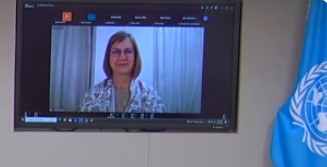
Akm Shehabuddin Kisslu: UN Women Special Representative in Afghanistan, Susan Ferguson urge to all governments and other international donors to continue investing in Afghan women and girls. To increase, not cut their foreign aid. Because to do anything less is to walk away from Afghan women and girls would be another step towards normalization. In a press briefing at the United Nations on Friday, Ferguson said, there is nothing normal about excluding half a country’s population from public life. There was nothing normal about it five years ago. There is nothing normal about it today. And we must never allow it to become normal. Every woman’s organization we surveyed in April reported an increase in women’s economic vulnerability and poverty. And more than eight in ten reported an increase in early and forced marriage, she added. Five years into this crisis, this is the moment to deepen our commitment to Afghan women – not retreat from it.
UN Women Special Representative in Afghanistan, Susan Ferguson told Journalists “Afghanistan is the only country in the world where women and girls faces far-reaching restrictions on their education, work, movement, public participation, and legal equality.”
In the past year alone, new decrees and edicts have further restricted women’s and girls’ access to justice and formally removed equality between men and women before the law. Year by year, the de facto authorities have systematically dismantled the rights of women and girls, issuing more than 100 decrees that have stripped away their rights and institutionalized discrimination against them, She added.
“We are seeing just how profoundly these restrictions are reshaping women’s everyday lives,” Ferguson said, Women described a constant need to be aware of their dress, speech, and movements to avoid sanctions, scrutiny, or judgment.
This systematic loss of rights, freedoms, and opportunities has triggered a mental health crisis among women and girls. Seven in ten women we surveyed describe their mental health as ‘bad’ or ‘very bad’. These figures tell us what five years of systematic and growing exclusion looks like in the life of an Afghan woman according to the UN women special representative Ferguson.
Ferguson underscored that Women’s organizations are one of the last remaining lifelines for Afghan women and girls, delivering life-saving services including protection from violence, healthcare, mental health and psychosocial support, livelihoods and humanitarian assistance. Yet, nearly three-quarters of these organizations experienced funding cuts in 2025. Two-thirds reported they had six months or less of operational funding remaining. She said, More than half of these organizations said they had scaled back gender-based violence support, and two out of three said they had already scaled back education and income support Ferguson added. And these pressures extend beyond women’s organizations.
In June, a survey of more than 100 NGOs and UN entities found that more than half had been forced to let Afghan women staff go because of funding cuts according to Ferguson.
Afghanistan also remains prone to natural disasters and climate shocks, which can push already vulnerable families even further into crisis. This year, more than 10.7 million Afghan women and girls need humanitarian assistance. And 4.9 million women and children are expected to need treatment for malnutrition.
“So we are facing a stark contradiction. Despite operating in the world’s most severe women’s rights crisis. Despite being one of the last remaining lifelines for many vulnerable women and girls. Despite needs rising as poverty deepens and restrictions on women intensify… Ferguson said.
UN special representative said, More than half of the 3,200 women surveyed say they now leave their homes only once or twice a month. Nearly three-quarters say they feel unsafe leaving home without a male guardian, or mahram. And more than half say they avoid public spaces, such as markets and health facilities, altogether.
In the face of all these extraordinary restrictions, I hear the message over and over from the Afghan women I meet: see us, don’t leave us, stand with us, and continue to support us, Ferguson said.
Across Afghanistan, international aid cuts are forcing women’s organizations to cut services, lay off staff and, in some cases, consider closing their doors altogether. In fact, more than half of the 74 women’s organizations UN Women surveyed in April this year are likely to suspend work or close in the next year due to these aid cuts.
Explaining the situation on the ground Ferguson presented examples that , under Decree Number 12, a husband is only criminally liable for violence within marriage if he causes severe and visible physical injuries – and his wife must prove it in court, with her male guardian, who may be the very person who harmed her.
Under Decree Number 18, men retain the right to divorce, but a woman either needs her husband’s permission or to go through lengthy legal processes. The decree also implicitly permits child marriage, further eroding the rights and protection of women and girls.
Enforcement of these decrees and edicts has intensified, with thousands of officials now patrolling the streets with broad powers of detention and surveillance. The gates of high schools remain locked to girls. The halls of universities remain open to men only. And a growing shortage of women health workers – a consequence of the education bans – is making it harder for women to receive health care, particularly in communities where custom prevents women from being treated by male doctors.
The Taliban seized control of Afghanistan for the second time five years ago. What has unfolded since then has no parallel in the modern world.

