


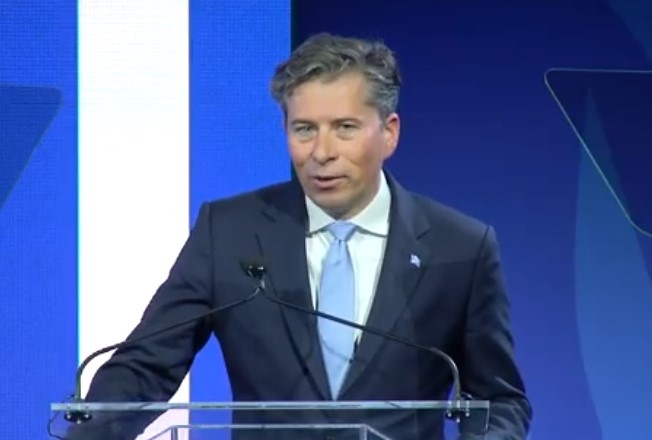
Akm Shehabuddin Kisslu : Under-Secretary-General of the UN for humanitarian affairs and emergency relief coordinator, Tom Fletcher said the states dominating the violence and killing humanitarians must be accountable.” Nearly 1,000 aid workers killed, injured or kidnapped,” he said we will not allow this violence, this killing of humanitarians, to be normalized. Under-Secretary-General Fletcher made his remarks on the world humanitarian day joining Stephen Dujarric ( spokesperson for the UN secretary General) at the daily press briefing at the UN headquarter in New York from Ukraine.
“We need the international community to uphold the law. The law is meant to protect us, meant to protect civilians from all weapons, however sophisticated they are. So we need those investigations. We need accountability,” Fletcher said. And behind it all, this sense we feel of impunity, of a lack of accountability for those who pulled the trigger, those who gave the order, those who supplied the weapon, those who created the environment in which it could be used in that way, he added.
Honoring the memory of friends and colleagues across the global humanitarian effort, he said, “We do grieve today but we recommit to this mission, the mission that they loved and ultimately died for. We recommit to that mission in their memory.”
While staying in Ukraine, Under-Secretary-General said, he has been in Kherson for the last two days, which is a real epicenter at the moment – it’s saturated by use of drones against civilian areas.
“I was really struck – I drove the road four times, actually, that Ukrainians call the “Road of Death,” between Mykolaiv and Kherson, and until you see it and experience it, it’s hard to describe driving for miles and miles, kilometres, kilometres along these roads covered in netting to try and keep out as many of the drones as possible. That sense when you’re walking around of the constant threat, the alarms going on everyone’s phone incessantly, and the sense of collective anxiety that these drones create, Under-Secretary-General Fletcher said.
“It’s become one of the places, I’m afraid he said, where you get to really understand this dystopian reality that lies ahead, potentially, for many of us, but is an existence day to day for people here and in so many of the crisis areas in which we work, from Somalia to Sudan to Gaza to Lebanon.
Referring to the remarks by Stephen Dujarric Fletcher said said, this day was born from tragedy, the Canal Hotel bombing 23 years ago. But those tragedies are now continuing day to day, and we’re seeing them increasingly powered by a chilling alliance between technological ingenuity and modern warfare, and the victims are civilians and they are humanitarians.
While taking about the Ukraine Tom Fletcher also talked on use of modern technology Drone,” we need the companies who are manufacturing and supplying these weapons to understand international humanitarian law, to understand how these weapons are being used and to understand their obligations and responsibilities.” we need States to uphold the law, He said.
Fletcher expressed concerns that Member States is not doing enough.
Fletcher responded to a question ,”we need a dialogue with the companies involved in supply and distribution of this new deadly technology to make sure they really understand the risks that they are creating and their obligations under international law as well. And then we need to have a strong, robust conversation about international humanitarian law in the 21st century and try to make sure that our enforcement of the rules keeps up with the deadly innovation, in this case that we’re seeing. This shouldn’t be beyond us. The world has had to adapt to modernization of warfare again and again.
Under-Secretary-General Fletcher said, everyone – from the kids I met in shelters, civilians, humanitarians, my colleagues – he said, can tell the difference between the sound of a first-person-view drone and a fibre-optic drone and the medium-range drones or the loitering munitions, which are such a threat to our work. And so these weapons have become part of life and part of the language of people here, and that’s pretty chilling.
“So you see this dystopian reality of these kill zones and kamikaze drones increasingly putting lethal power into the hands of more people, and all of that without the accountability that […].
We have a sense that it’s not just the killer, who’s further from the victim, but that accountability and justice are further from the victim, and that the technology is changing every week as these drones become more sophisticated’” he added.
You know, my family name is Fletcher; he said, ‘we were arrow makers.’ The world adjusted to a world of arrow makers, it adjusted to a world of gunpowder. It created rules to protect people from nuclear weapons, ballistic weapons, and chemical weapons. Those rules apply to these drones, but they are not being applied in the way that they should.
Fletcher said, this isn’t just a Ukraine story. I’ve seen the way that armed drones are transforming war around the world. I was told in Somalia a few weeks ago by women that they were fleeing not famine or violence, but the drones that are following them round, as people are experimenting with cheaper and cheaper and more available technology. So, from Sudan to Colombia to Gaza to Lebanon, these cheap armed drones are extending the reach of war and allowing people to kill at greater distance. A thousand civilians killed in Sudan in the first five months of the year.
World need to ensure that if the global economy is being put, as it is, on a war footing, that we are also training these weapons in the right way, he said, and that we’re also ensuring that technology does not outpace humanity and that technology does not outpace accountability.
When asked, Under-Secretary-General of the UN for humanitarian affairs underscored the needs of resources to provide those to all our partners in the field to face challenges about how we protect ourselves, particularly from drones, in the future, and how we adapt protection of our colleagues.
Firstly,as humanitarians, you know, we’re here to help survivors, he added.
Responding to a question on Gaza, Under-Secretary-General Fletcher said, it’s been a very, very rough few years for our work, of course, in Gaza, Lebanon, elsewhere. But it’s been much rougher for the civilians that we serve, and you know, but I wouldn’t characterize it as the dismantlement of the UN humanitarian system. We’re still here, and we’re still doing our work in Gaza and elsewhere. We’ve made real inroads, as, in handling the hunger levels in Gaza, for example, with over a million hot meals a day. You know, over that last year, since the 20-Point Plan, since the Sharm El-Sheikh meeting, we’ve got a lot more food in, and we are turning the corner on the hunger situation.
Of course, we’ve got much, much further to go. We’ve got to get shelter materials in for the winter. We’ve got to get all the crossings open. We’ve got to get the full range of our NGO partners operating in the way that we need them to operate. We’ve got to get the protections for civilians in place from airstrikes he said.
Fletcher said, In Gaza, across the West Bank, in Lebanon, but globally, the UN humanitarian system has taken the shocks to it and continues to operate. And we’re out there right now, looking to reach 87 million people this year with life-saving support, as you’ve heard me describe, and we’re not retreating from that challenge, either because of these weapons being used against us, or because of the scale of the challenges in places like Gaza, Sudan, Yemen and beyond, where our work is under such threat.

