


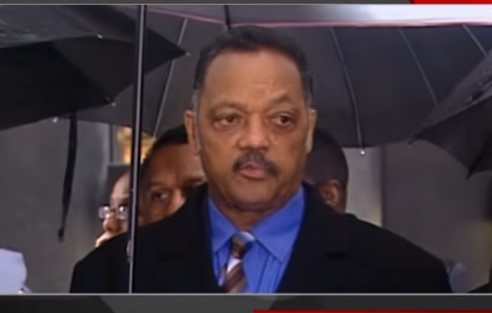
Newsman: The Rev. Jesse Jackson, a towering civil rights icon who battled alongside Martin Luther King Jr., negotiated global hostage releases, and shamed corporations for their lack of corporate diversity and failure to support voting rights has passed away. He was surrounded by his family. Tuesday morning his family said in a statement.
“Our father was a servant leader — not only to our family, but to the oppressed, the voiceless, and the overlooked around the world,” the family statement said.
“We shared him with the world, and in return, the world became part of our extended family. His unwavering belief in justice, equality, and love uplifted millions, and we ask you to honor his memory by continuing the fight for the values he lived by,” it added.
Jackson is survived by his wife, Jacqueline Jackson, whom he married in 1962, and six children. Reverend Jesse Jackson was 84.
Civil rights activist Reverend Jesse Jackson Jackson was hospitalized on Nov. 12 following a lengthy battle with the progressive neuromuscular disease progressive supranuclear palsy, a condition similar to Parkinson’s disease. He was a Presidential Medal of Freedom recipient, a Democratic presidential candidate and one of the world’s best-known Black activists.
“It is with profound sadness that we announce the passing of Civil Rights leader and founder of the Rainbow PUSH Coalition, the Honorable Reverend Jesse Louis Jackson, Sr.,” said a statement from the organization on Instagram. “He died peacefully on Tuesday morning, surrounded by his family.”
Despite the illness that softened his voice and weakened his steps, he had continued to advocate for civil rights, and was arrested twice in 2021 over his objection to the Senate filibuster rule. That same year he and his wife Jacqueline were hospitalized with COVID-19 complications at a Chicago hospital.
The making of a Civil Rights icon
Jackson born to a teen mother and her married neighbor in 1941 fall in Greenville, South Carolina. Jackson was adopted by the man his mother married, and he considered both to be his fathers. He attended a segregated high school and played football in college, dropping out a few credits short of his master’s degree in divinity in 1966 to join the civil rights movement full-time.
Jackson’s rise to prominence began after he and seven other men were arrested in 1960 ‒ he was 18 at the time ‒ for protesting segregation at their town’s public library. He then joined King burgeoning civil rights fight, and was just feet away when King was assassinated in 1968.
By 1965, he’d marched with King and others from Selma to Montgomery to push for Black voting rights, and by 1967 was running operations for King’s Southern Christian Leadership Conference in Chicago, the city that would become his home.
Under Jackson, the SCLC’s Operation Breadbasket used boycotts and public attention to pressure companies to hire more Black workers. Jackson ultimately earned his divinity degree after being ordained a minister in 1968.
Beginning his career as a protégé of Dr. Martin Luther King Jr., Jackson quickly rose to become one of the nation’s most prominent and influential civil rights leaders. In 1971, he formed the nonprofit Operation PUSH – People United to Save/Serve Humanity – to advocate for social and economic parity for Black Americans.
Jackson participated in many of the civil rights movement’s landmark moments, including the March on Washington in 1963, where King delivered his famous “I Have a Dream” speech, and the Selma to Montgomery marches in Alabama in 1965. He was also with Dr. King when the civil rights leader was fatally shot at the Lorraine Motel in Memphis, Tennessee, on April 4, 1968.
Three years after King’s murder, Jackson left the SCLC and founded Operation PUSH, a social justice organization dedicated to improving the economic conditions of Black communities across the U.S.
The organization fought for greater educational and employment opportunities for Black Americans and was successful in compelling major corporations to adopt affirmative action policies benefiting Black workers.
Jackson founded what would ultimately become the Rainbow/PUSH Coalition, and ran for president as a Democrat in 1984 and 1988, energizing and registering millions of Black voters.
“As we continue in the struggle for human rights, remember that God will see us through, even in our midnight moments,” Jackson said in 2017 as he announced his neuromuscular disease diagnosis.
Jackson ran for president twice, both times as a Democrat, placing third for the party’s nomination in 1984 and second in 1988, marking the most successful presidential runs of any Black candidate prior to Barack Obama’s two decades later.
As only the second Black American to mount a nationwide presidential campaign, after New York Rep. Shirley Chisholm in 1972, Jackson’s historic runs were the most successful by a Black candidate until President Barack Obama won in 2008.
Jackson ultimately did win political office, when he was elected to serve in the U.S. Senate as a shadow delegate for the District of Columbia, from 1991 to 1997.
In 1983, shortly before announcing his run for president, Jackson traveled to Syria to negotiate the release of an American pilot shot down over Lebanon, and the next summer, negotiated the release of 22 Americans and 26 political prisoners from Cuba after meeting with former dictator Fidel Castro.
His successes bolstered his presidential campaign, although he lost the primary to Walter Mondale, who went on to lose to Ronald Regan. Jackson ran again for president in 1988, putting on a strong showing but ultimately falling to Mike Dukakis, who eventually lost to George H.W. Bush.
After that second loss, Jackson shelved his own political aspirations but continued his efforts for civil rights and justice.
In 1990, Jackson opposed the pending invasion of Iraq and negotiated the release of hundreds of people who Iraqi dictator Saddam Hussein had threatened to use as human shields, and then in 1999 won the release of three U.S. POWs during the Kosovo War.
In 2000, Clinton awarded Jackson the Presidential Medal of Freedom, citing his decades of work to make the world a better place.
“It’s hard to imagine how we could have come as far as we have without the creative power, the keen intellect, the loving heart, and the relentless passion of Jesse Lewis Jackson,” Clinton said.
He opted instead to attend the University of Illinois before transferring to and graduating from North Carolina A&T, a historically Black university. He then began theological studies before going to work full-time with Dr. King and the Southern Christian Leadership Conference (SCLC). He was ordained a Baptist a minister in 1968.
In 1966, 24-year-old Jackson became head of the Chicago Chapter of the nascent Operation Breadbasket, the economic activism arm of the SCLC, and was appointed its national director the following year. He also helped establish the Chicago Freedom Movement to work for open housing and school desegregation.
Jackson’s social activism evolved into political ambition in in the 1980s, when he launched two campaigns for the Democratic presidential nomination, in 1984 and 1988. He placed third in primary voting in 1984 and came in second to Democratic nominee Michael Dukakis in 1988, winning 12 primaries and caucuses and receiving some 6.9 million total votes.
In later years, Jackson was a vocal proponent for the reauthorization of the 1965 Voting Rights Act. He was also involved in the United Kingdom’s Operation Black Vote to promote minority participation in British elections. In July 2023, Jackson stepped down as head of the Rainbow PUSH Coalition after more than 50 years as its head. “We’re resigning, we’re not retiring,” Jackson said at the time, vowing to continue fighting for social justice causes.

