


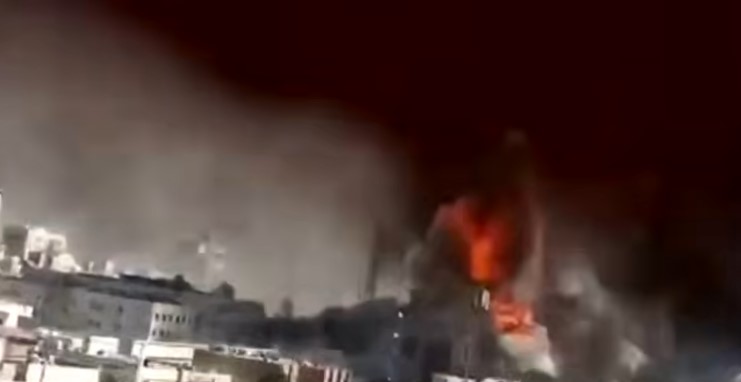
Newsman: the United States and Israel launched a large-scale offensive against Iran after weeks of military buildup and threats from President Trump. Israel and the United States began a series of strikes targeting Iran’s leadership, security forces and nuclear program and missile sites. They said they aimed to induce regime change in Iran and to address concerns regarding its nuclear program. The strikes are reported to have caused both military and civilian casualties in Iran.
In response, Iran has launched a series of counter-strikes against Israel, US military bases in the region, and military and civilian locations in Arab states that house US forces. UK bases in Bahrain, Qatar and Cyprus have also been attacked and the RAF has been deployed in a defensive capacity. The extent of military and civilian casualties is uncertain, as is the trajectory of the conflict.
On February 28, Israel and the United States launched attacks against Iran. In a Truth Social post, Trump said the goal of the operation is to prevent Iran from obtaining a nuclear weapon and “to defend the American people by eliminating imminent threats from the Iranian regime.” Trump urged Iranians to capitalize on the attack as the “only chance for generations” to take over their government. Trump and Israeli officials later confirmed that Israel Defense Force (IDF) strikes on Tehran killed Iranian Supreme Leader Ayatollah Ali Khamenei.
Additional U.S. strikes targeted military sites in Isfahan, Karaj, Kermanshah, Qum, and Tabriz. Iran quickly retaliated by firing ballistic missiles at Israel and U.S. facilities across the Middle East, including in Bahrain, Kuwait, Qatar, and the United Arab Emirates.
Israel’s Prime Minister Benjamin Netanyahu echoed many of President Trump’s comments, saying that Iran was seeking to rebuild its nuclear programme and missile capabilities. In his statement announcing the operation, Benjamin Netanyahu said that the operations would “continue as long as necessary” and called on Iranians to “take their destiny into their own hands”.
On 28 February, Israel’s Defence Minister, Israel Katz, said that the country’s armed forces had launched “pre-emptive attack” on Iran.
There were extensive protests in Iran in early 2026, motivated by a weakened economy as well as struggling infrastructure, illustrating the regime’s weakened legitimacy within the country. The protests were put down with extensive use of force. Some student protests had resumed in late February.
In a statement on Truth Social, posted on 28 February 2026, President Trump set out that Iran posed a threat to “core national security interests of the US”. He said:
The US had been unable to reach a diplomatic agreement with Iran in February to curtail its nuclear program .the Iranian regime was instead continuing to expand its nuclear and ballistic missile .
President Trump said that the military action would “annihilate” the Iranian navy, destroy Iran’s missile sites and program and weaken the network of Iran-backed terrorist and armed groups across the region.
President Trump also reiterated his assessment that the joint US-Israel military action carried out in June 2025 had “totally obliterated” Iranian nuclear sites. Some eight months on, however, the International Atomic Energy Agency (IAEA) has been unable to resume inspections in Iran.
The US told the UN Security Council that the action was taken under Article 51 of the UN charter (referring to self-defense until the council takes action) and that Iran had been in breach of several UN Security Council resolutions, such as those limiting its nuclear program.
Iran has long said it does not seek a nuclear weapon, though its enrichment level is above that needed for civilian uses and there has been greater public in Iran debate proposing such a move. The 2025 US intelligence community assessment had judged Iran was not building a nuclear weapon.
On Iran’s ballistic missile program a 2025 report by the US Defense Intelligence Agency had said Iran could potentially “develop a militarily-viable [intercontinental ballistic missile] by 2035”, but did not state if Iran had decided to pursue this. As set out in a US Congressional Research Service report, Iran has long had missiles capable of targeting sites across the Middle East and parts of southern Europe.
Statements on regime change or new Supreme Leader
The US President Donald Trump has also called on Iranians, “when we are finished, to take over your government”.
Following the announcement of the death of Iran’s Supreme Leader, Ali Khamenei, President Trump said that “this is the single greatest chance for the Iranian people to take back their country”. He called on the Iranian security forces and the Islamic Revolutionary Guard Corps (IRGC) to lay down their arms and “peacefully merge with the Iranian patriots” and “work together as a unit to bring back the country to the greatness it deserves”.
However, the President has also suggested that Iran could choose a successor to the supreme leader. In an interview with the New York Times, he described “what we did in Venezuela [as] the perfect scenario […] [where] everybody’s kept their job except for two people”. This refers to the US capture of Venezuelan President Nicolás Maduro and his wife and the swearing in of his vice president as his successor.

