


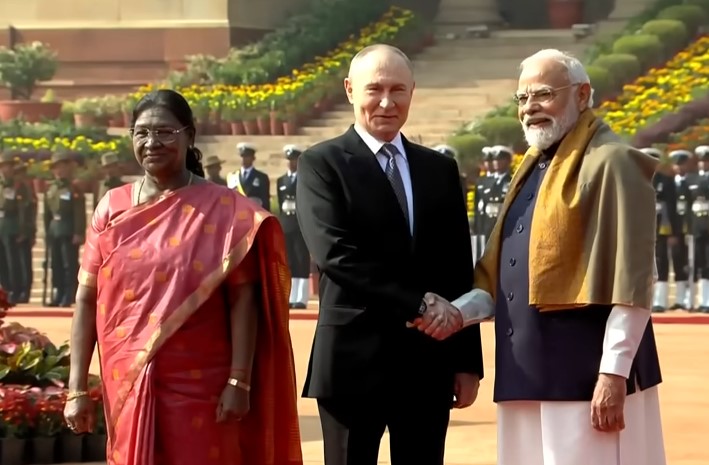
Newsman: Russia has reaffirmed its long-standing energy partnership with India, with President Vladimir Putin declaring that Moscow will remain a steady, uninterrupted supplier for the country’s fast-growing economy. Russian President Vladimir Putin said Friday he was ready to continue “uninterrupted shipments” of fuel to India, as New Delhi faces heavy US pressure to stop buying oil from Moscow.
While addressing the joint press address with Prime Minister Narendra Modi, he said the two countries are seeing “successful partnership in energy,” adding that “Russia is a reliable supply of oil, gas, coal and everything that is required for the development of India’s energy. We are ready to continue uninterrupted shipments of fuel for the fast-growing Indian economy.”
Putin noted that cooperation is expanding well beyond conventional fuel. He highlighted the major joint nuclear power initiative already underway, saying Russia is conducting “a flagship project to build the largest nuclear power plant in India.”
Russian President Vladimir Putin is in India for his two-day India visit, where he held summit talks with Prime Minister Narendra Modi in New Delhi. Putin aiming to boost trade with the top buyer of Russia’s arms and seaborne oil as Western sanctions squeeze their decades-old ties.
Prime Minister Narendra Modi, who is hosting Putin at a summit in New Delhi dominated by energy, defence and trade talks, thanked the Russian leader for his “unwavering commitment towards India”. India’s Modi and Putin are also expected to discuss other topics, including labour and civil nuclear energy, with the sides expected to announce new agreements to showcase the resilience of their relations.
India and Russia have confirmed their readiness to intensify trade and investment cooperation in the Far East and the Arctic zone of the Russian Federation, according to a joint statement issued on Friday after the meeting here between Prime Minister Narendra Modi and President Vladimir Putin.
Prime Minister Narendra Modi and Russian President Vladimir Putin held an extensive range of talks aimed at strengthening the Special and Privileged Strategic Partnership between India and Russia.
Official Spokesperson for the Ministry of External Affairs, Randhir Jaiswal, said that the leaders witnessed the exchange of several documents.
Earlier in the day, PM Modi welcomed Putin at Hyderabad House to participate in the 23rd India-Russia Annual Summit.
Russian President Vladimir Putin on Friday said early signing of the preferential trade agreement between India and the Eurasian Economic Union (EAEU) will reduce barriers to facilitate the movement of goods, services and capital. India and the Eurasian Economic Union held the first round of negotiations for the free trade pact last week.
India and the five-nation grouping, the Eurasian Economic Union (EAEU), on August 20, inked the terms of reference for the agreement.
Russia, Armenia, Belarus, Kazakhstan, and Kyrgyzstan are the five member countries of the EAEU.
The Programs of India-Russia Cooperation in Trade, Economic and Investment Spheres in the Russian Far East for the period from 2024 to 2029 provides the necessary framework for further cooperation between India and the Russian Far East region, especially in the sectors of agriculture, energy, mining, manpower, diamonds, pharmaceuticals and maritime transport.
Both sides underscored the importance of holding regular bilateral consultations on Arctic-related issues and welcomed the progress made in multi-faceted bilateral cooperation on the Northern Sea Route.
Russian leader Putin’s agenda on December 5 included a ceremonial welcome at Rashtrapati Bhavan, tributes at Rajghat, delegation-level talks with PM Modi, followed by a joint press statement, a business event with the Federation of Indian Chambers of Commerce and Industry, and a meeting with President Droupadi Murmu at the Rashtrapati Bhavan before his departure in the evening.
Moscow has been India’s top arms supplier for decades and has said that it wants to import more Indian goods in an effort to grow trade to $100 billion by 2030 that so far has been skewed in its favour due to New Delhi’s energy imports.
The Russian leader is on his first visit to India in four years at a time when New Delhi is engaged in talks with the US for a trade deal to cut punitive tariffs imposed by President Donald Trump on its goods over India’s Russian oil purchases.
President Putin said Russia is for strengthening its multifaceted relations with India in various fields
India is pursuing an independent and sovereign policy under the leadership of PM Modi and achieving very good results, Russian President Vladimir Putin said on Friday, noting that the Indian economy is one of the fastest-growing in the world.
Addressing the India-Russia Business Forum in New Delhi, President Putin said that due to initiatives by PM Modi such as the Make in India programme, India is becoming technologically sovereign. India And Russia Will Take Bilateral Trade To $100 Billion, Says Vladimir Putin
He said that the Russian delegation did not only come to discuss energy issues and sign contracts for the supplies of oil and gas.
“What we want is the development of our multifaceted relations with India in various fields. Prime Minister stressed on many occasions in our private talks that India has vast and growing opportunities in many fields, but up until now they haven’t been used to the extent both parties want to see it. That is precisely the reason why we convened this forum,” he said.
Noting that India is emerging as the world’s skilled capital and the country’s young talent has the potential to meet global requirements, Prime Minister Narendra Modi on Friday said that India and Russia are embarking together on a new journey of innovation, co-production and co-creation.
Addressing the India-Russia Business Forum, PM Modi said the goal of the two countries is not limited to increasing mutual trade, but they want to ensure the well-being of all humanity and need to develop sustainable solutions to global challenges.
He urged Russian businesses to “Come, Make in India, Partner with India”.
India and Russia ‘walk together in the fight against terrorism’, Prime Minister Narendra Modi said Friday afternoon in a joint statement with Russia’s Vladimir Putin.
Emphasizing the significance of cultural ties between India and Russia, Prime Minister Narendra Modi on Friday said that people-to-people connections have always held a special place in bilateral relations and New Delhi will soon launch a free 30-day e-tourist visa and a 30-day group tourist visa for Russian citizens.
In a joint press statement with Russian President Vladimir Putin following their talks at the Hyderabad House in New Delhi on Friday, PM Modi stated that for decades, the people of both countries have shared deep affection, respect and warmth for one another and that several new steps have been taken to deepen these bonds.
“Recently, two new Indian consulates have been opened in Russia. This will facilitate smoother contact between the citizens of both countries and enhance mutual closeness. Earlier this October, hundreds of thousands of devotees in ‘Kalmykia’ received the blessings of the sacred relics of Lord Buddha at the International Buddhist Forum,” PM Modi stated.
Modi, who warmly embraced Putin on the airport tarmac when he arrived on Thursday, also reiterated India’s support for a peaceful resolution to the war in Ukraine.
Putin received a ceremonial welcome on Friday on the forecourt of Rashtrapati Bhavan, the colonial-era presidential palace, with a 21-gun salute as his convoy drove in.
At a joint press meet with Prime Minister Narendra Modi, Russian President Vladimir Putin said, “We are conducting a flagship project to build India’s largest nuclear power plant at Kudankulam. Two of the six reactor units are already connected to the grid, while four more are under construction. Bringing this plant to full capacity will make an impressive contribution to India’s energy needs, providing cheap and clean power for industries and households. We can also discuss small modular reactors, floating nuclear plants, and non-energy uses of nuclear technology, including in medicine and agriculture. We are working with our Indian partners to build new international transport and logistics routes, including the International North–South Transport Corridor from Russia and Belarus to the Indian Ocean. There are major opportunities for bilateral trade with the expansion of this corridor, including its key link -the Northern Sea Route.”
Russian President Vladimir Putin said, “The Prime Minister gave us a list of challenges that deserve the attention of both governments, and we will act on them. The creation of a Free Trade Agreement between India and the Eurasian Economic Union will help. Our countries are gradually moving to mutual settlements in national currencies, which already account for 96 per cent of commercial transactions. We are also witnessing successful partnerships in energy – stable supplies of oil, gas, coal, and everything required for India’s energy needs.”
PM Narendra Modi said, “India and Russia have long been standing shoulder to shoulder in the fight against terrorism. Whether it is the terrorist attack in Pahalgam or the cowardly attack on the Crocus City Hall, the root of all these incidents is the same. India’s unwavering belief is that terrorism is a direct assault on the values of humanity and that global unity against it is our greatest strength. India and Russia have close cooperation in the UN, G20, BRICS, SCO, and other forums. We will continue our dialogue and cooperation in all these forums…”
Putin challenges Washington
In an interview with broadcaster India Today aired late on Thursday, Putin challenged U.S. pressure on India not to buy Russian fuel.
“If the U.S. has the right to buy our (nuclear) fuel, why shouldn’t India have the same privilege?” he said, adding that he would discuss the matter with Trump.
Energy trade with India is “running smoothly” despite a minor dip in the first nine months of 2025, he said.
India has said Trump’s tariffs are unjustified and unreasonable, noting continued U.S. trade with Moscow. The U.S. and European Union still import billions of dollars worth of Russian energy and commodities, ranging from liquefied natural gas to enriched uranium, despite economic sanctions.
Since European countries have sought to cut their reliance on Russian energy over the Ukraine war, India ramped up its purchases of discounted Russian crude, only to reduce them under pressure from U.S. tariffs and sanctions this year.

